Canadians Enjoy FREE Shipping & Handling for a limited time!
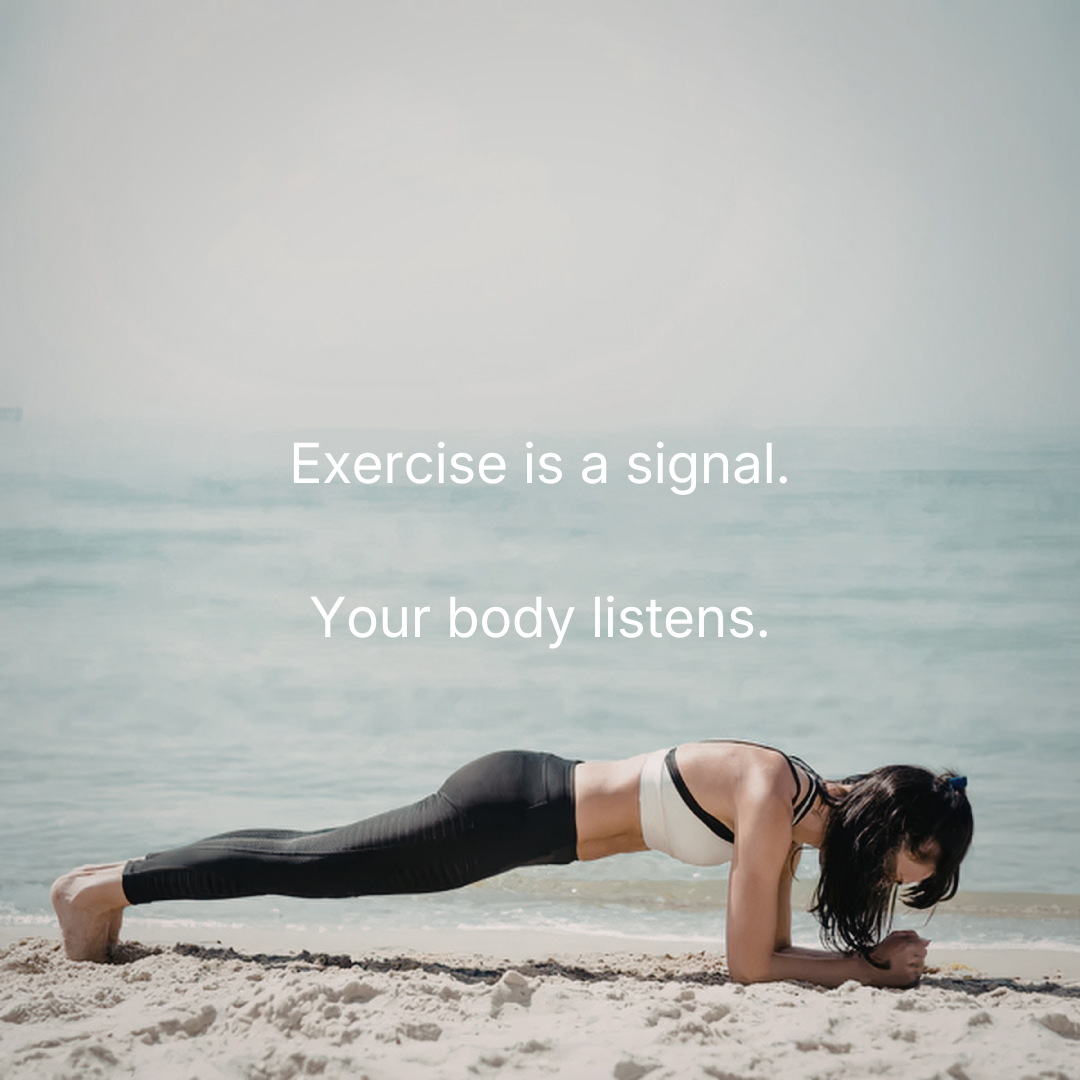
When movement becomes part of daily life, the system responds with greater stability across energy, mood, sleep, and resilience.
Exercise is often framed as something you do to your body.
Burn calories. Build muscle. Improve endurance.
But biologically, exercise works in the opposite direction. It sends information inward, triggering responses that influence how the body adapts, recovers, and functions over time.
Muscle tissue releases signaling molecules during contraction. These signals affect organs involved in metabolism, immunity, and brain health.
This is why exercise can improve energy, mood, and resilience even without visible physical changes.
The body interprets movement as a sign of demand and adapts accordingly.
As daily movement becomes minimal or inconsistent, the signals normally generated by muscle contraction disease.

Over time, this can reduce the body's responsiveness to exercise itself. Energy regulation becomes less efficient. Recovery slows. Motivation feels harder to access.
This feedback loop explains why restarting movement after long breaks often feels so much harder than expected.
Consistent movement contributes to healthier sleep patterns, which directly influence how prepared the body feels to move again.
Nutrition support exercise adaptation, while active muscles process nutrients differently than inactive ones.
These systems reinforce one another. When one weakens, the others feel it.
Maintaining muscle mass supports independence, metabolic health, and recovery capacity.
Strength supports day-to-day capability more than peak performance.
Small, consistent signals add up over time.

Exercise doesn't need to be extreme to be efficient.
It needs to be consistent enough for the body to recognize the pattern.
When movement becomes part of daily life, the system responds with greater stability across energy, mood, sleep, and resilience.

Feeling the summer slump? MAKE Wellness shares a simple 3-step energy reset to boost focus, motivation, and vitality even during busy summer days.
read
Here’s the thing - real sleep isn’t supposed to feel like being “knocked out.”
read
